
The 30-day marketing challenge works like this. You pick one channel, one audience and one offer, you show up on that channel every working day for 30 days, and you track three numbers. One channel will give you evidence, not guesswork. It will also take less of your week than the scattered version of marketing you are running right now.
In this post
- I have started from zero three times, and this is exactly what I did
- Why marketing everywhere at once will quietly wear you down
- What a one-channel challenge actually means
- How to choose the one channel worth 30 days
- The 30-day challenge week by week
- Where AI will save you hours without making you sound like everyone else
- What Basket Treats taught me about picking one channel
- How you will know if the 30 days worked
- Download the 30-day one-channel marketing challenge template
- What happens on day 31
- Frequently asked questions
I have started from zero three times, and this is exactly what I did
Let me start with the part that is not comfortable to publish.
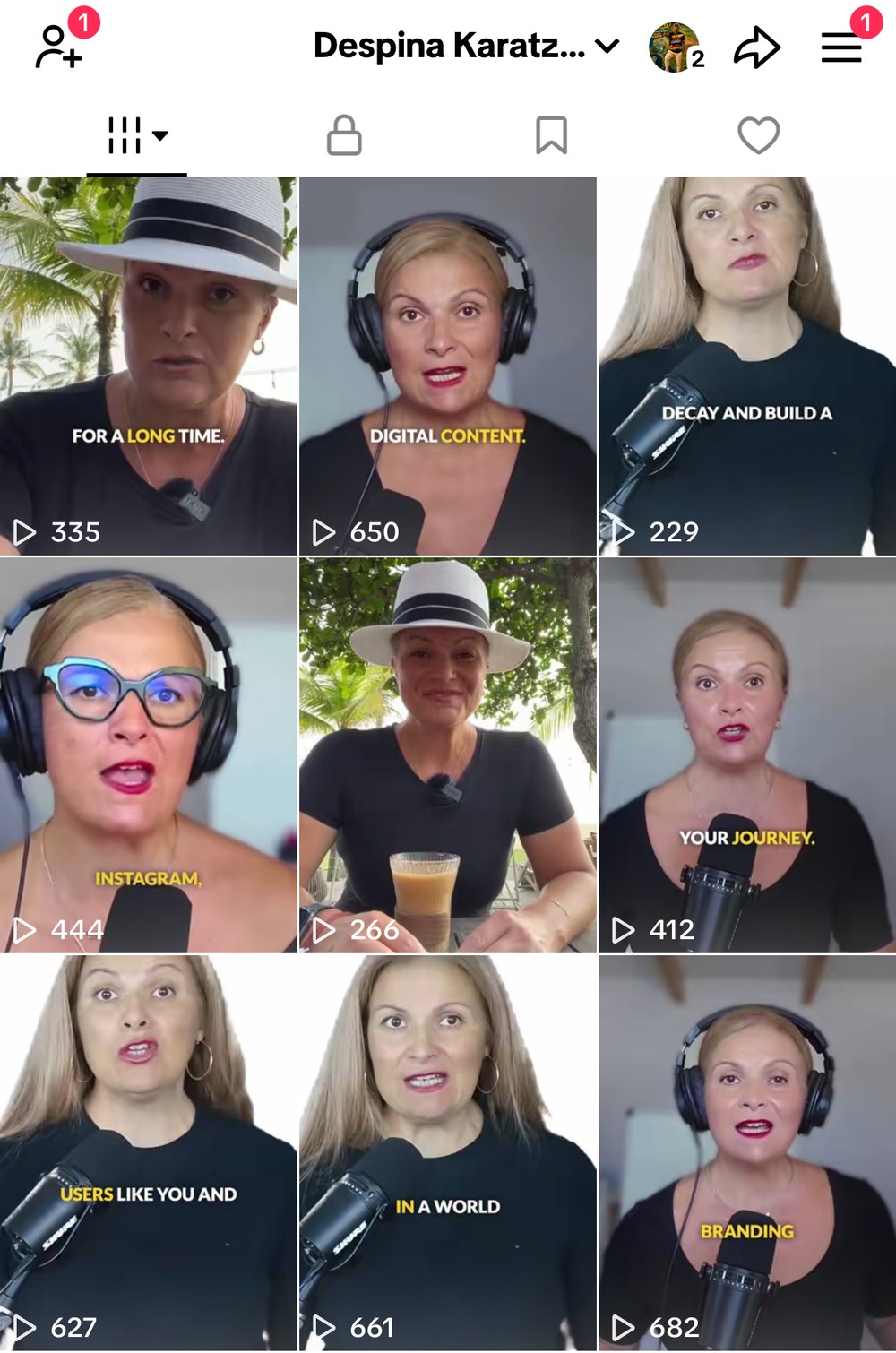
Two years ago I was the new kid on TikTok. I had put my first video on YouTube back in 2009, I had trained thousands of business owners in between, and none of that bought me a single thing on a new platform. No audience. No algorithm goodwill. A face that had clearly not yet made peace with being in front of a phone.
You can go and watch it happen. My TikTok is at @desikaratzias and my YouTube goes all the way back to 2009 at @DespinaKaratzias.
Go back to the early videos. You will see the clunky, awkward batching efforts of someone learning a format in public. I have left them up on purpose.
In between those two there was a third. I launched The Tourism Hub Podcast in 2016, one of the first podcasts anywhere with a tourism lens, and I built it the same way. One channel. One audience. One offer. Turn up, record, publish, keep going. It is the channel that now feeds almost everything else I make.
What I did next is the exact strategy in this post, and it is the third time I have used it. YouTube in 2009. The podcast in 2016. TikTok two years ago. Same rules every time. One channel. One audience. One offer. Show up, batch the content, keep going.
The result was not a viral story and I am not going to pretend otherwise. The videos landed at roughly 400 views, consistently. Consistently is the word that matters. A channel that gives you a predictable number is a channel you can build on. A channel that gives you one spike and then silence is a lottery ticket.
Creating content is like going to the gym. You will feel awkward at the start, you will not love the early footage, and you will never once regret the session you actually turned up for. The weeks you skip are the only ones you regret.
So this post is not theory I read somewhere. It is what I did three times across fifteen years, written down so you can do it in 30 days without wrecking yourself in the process.
Get the template first
The 30-day one-channel marketing challenge template is a free download. It holds your three decisions, your day one baseline, a plan for each of the four weeks, a 30-day tracker and a day 30 review page.
Print it and fill it in as you read, or work in the spreadsheet version if that suits you better. Both are free. Add your name and email and the file lands in your inbox.
Get the printable workbook | Get the spreadsheet tracker
Why marketing everywhere at once will quietly wear you down
Most business owners I work with are not lazy marketers. They are exhausted ones.
They have an Instagram account, a Facebook page, a LinkedIn profile they update when they remember, a newsletter that went out twice last year, a Google Business Profile someone set up in 2019, and a TikTok account they opened because a friend told them to. None of it is running properly. All of it is sitting in the back of their mind as a job they are behind on.
The effort is going up. Constant Contact’s Q2 2026 Small Business Now report, based on more than 5,000 responses including 3,340 small and medium businesses, found that 67.3% of owners across Australia and New Zealand have increased the time they spend on marketing this year and 64.4% have increased their marketing budget.
More hours in. More money in. Very little clarity about which of it is working.
The cost shows up somewhere, and it is measurable. Xero’s Emotional Tax Return research, released on 28 May 2026 from a survey of 500 Australian small business owners, found that stress costs owners more than four hours of productive work every week, which Xero puts at around 29 working days a year. The same research found 31% have considered walking away from their business because of stress and 73% cannot switch off from work at all.
Regional operators are carrying more of it than they were. The 2026 COSBOA and CommBank Small Business Perspectives Report, which surveyed 572 regional Australian small businesses, found 77% experienced stress or anxiety in the past 12 months and 66% experienced burnout. In the 2025 edition those figures were 76% and 57%. Stress held steady. Burnout climbed nine points in a year.
Marketing is not the only cause of that. It is a reliable contributor, because it is the job that never announces it is finished.
Here is the part that matters for the Intelligence pillar. Running six channels badly is not a marketing problem. It is a decision problem. Nobody ever sat down and chose those six channels. They accumulated, one platform at a time, in response to whatever felt urgent that month. That is reactive. The fix is not more effort. The fix is a decision you make on purpose and hold for long enough to read the result.
Key takeaways
- Effort is already high. Two thirds of ANZ small business owners increased their marketing time in 2026.
- Stress costs Australian owners around 29 working days a year, according to Xero. Unfocused marketing is not free.
- Burnout among regional small businesses rose from 57% to 66% in a year.
- A channel list that accumulated by accident is a strategy problem, not a content problem.
What a one-channel challenge actually means
The rules are short on purpose. You can hold all of them in your head while you are standing in your own business at 6am.
- One channel. The single place you will show up every working day for 30 days.
- One audience. Not everybody who might buy. One group you can picture.
- One offer. The thing you want more of over the next quarter.
- One time slot. The same window every day, written in your diary like a customer booking.
- Three numbers. Visibility, engagement and conversion, recorded on day one and again on day 30.
- Thirty days. Long enough to read a pattern and get the behaviour started. A real habit takes closer to two months, which is why day 31 matters as much as day one.
That fourth rule looks like the least important one and it is doing the most work. A meta-analysis by Sheeran, Listrom and Gollwitzer covering 642 tests across 294 reports found that implementation intentions, meaning specific if-then plans about when, where and how you will act, reliably change behaviour and outcomes, with a sample-weighted effect size of d = 0.36.
In plain terms, deciding in advance beats deciding daily. “I will film tomorrow” fails. “I film at 7:15am at the kitchen bench before I open the laptop” holds.
What it is not matters just as much.
It is not a vow of silence everywhere else. Your other channels stay switched on. Reply to your messages. Keep your Google Business Profile accurate. What stops is the low-grade guilt of trying to grow all of them at once.
It is not a content sprint that ends in a crash. Daily does not mean long. A 40 second video, a two line answer to a customer question, a photo with a real caption, all of these count. If the daily action takes you more than 20 minutes, the plan is too ambitious for a business you also have to run.
And it is not a promise that this channel is your forever channel. It is a 30-day test with a decision at the end. That distinction is what makes it safe to commit to.
How to choose the one channel worth 30 days
Three tests. Run them in this order, because the first one will surprise you more often than the other two.
Test one. Where did your last 10 customers actually come from
Open your bookings, your invoices, your enquiry inbox. Take the last 10 paying customers and write down where each one found you. Word of mouth counts. A referral partner counts. A Google search counts.
Most owners have never done this, and most are quietly wrong about the answer. I have watched people spend a year feeding a platform that produced none of their revenue while the channel that produced most of it sat untouched.
Test two. Where does your audience already spend attention
Australians spend 41 hours and 3 minutes a week online, according to the Digital 2026 Australia report from DataReportal, We Are Social and Meltwater. The same research ranks how Australians find brands: search engines at 37.7%, word of mouth at 36.7%, TV ads at 32.7%, social media ads at 31.3% and brand websites at 25.3%.
Read that ranking properly. Word of mouth sits almost level with search. If test one told you that most of your customers arrived through a referral, your one channel might not be a social platform at all. It might be the referral partner you have never formally asked, or the review request you have never built into your process.
An honest caveat belongs here. DataReportal finds the typical adult discovers brands through around 5.8 different sources, so no single channel is doing all the work in a customer’s head. The argument for one channel is not that the others do not matter. It is that you cannot improve five things at once with the hours you actually have.
For context on what other small businesses are choosing, Constant Contact’s Q2 2026 research found 45.8% of ANZ small and medium businesses use unpaid social media, 41.0% use email marketing and 29.5% use paid social ads. Email sits closer to social than most owners assume.
Test three. Can you sustain the format on your worst week
Pick the channel whose format you can produce when the season turns, staff call in sick and the phone will not stop. If you hate being on camera, a daily video channel will beat you by day nine. If writing comes easily, that is a real asset, not a fallback.
I chose short video knowing I was bad at it. That was a deliberate trade, because the format matched where the audience was and I was willing to be awkward for a month. Be honest with yourself about which trade you are actually willing to make.
The best channel on paper loses to the good channel you will still be doing on day 27.
Key takeaways
- Start with evidence from your last 10 customers, not with a platform you feel guilty about.
- In Australia, search leads brand discovery at 37.7% with word of mouth right behind it at 36.7%.
- The average adult finds brands through around 5.8 sources, so one channel is a focus decision, not a claim that the rest are worthless.
- Choose the format you can repeat on a bad week, not the one that looks best on a good one.
The 30-day challenge week by week
The template that goes with this post lays all of this out with space to write in. Here is the shape of it.
Week one. Set the baseline and start
Days one to seven. Before you publish anything, record your three numbers as they stand today. Followers or search impressions. Comments, saves, replies or calls. Sales, bookings or list sign-ups. Write the date next to them.
Then publish every working day in your fixed time slot. Week one is about proving to yourself that the daily action is small enough to survive.
Week two. Find the rhythm
Days eight to 14. This is the week most people quit, which is exactly why the plan gets easier here, not harder. Batch your week in one sitting. Repeat the format that took you the least time last week.
Add one deliberate invitation to buy. Not five. One.
Week three. Test one variable
Days 15 to 21. Change one thing and hold everything else steady. Post at a different time of day, or lead with a question instead of a statement, or swap text for a short video.
One variable at a time is what turns 30 days of activity into 30 days of evidence.
Week four. Review and decide
Days 22 to 30. Keep publishing, and spend an hour at the end recording your three numbers again next to the day one figures.
Then make one of three calls. Keep this channel and roll it into your next quarter. Adjust the format or the audience and run another 30 days. Or change channels, taking the behaviour with you.
Key takeaways
- Record your three numbers before you publish anything. No baseline means no result.
- Batch the week in one sitting rather than deciding daily.
- Change one variable in week three so you can read what caused what.
- Finish with a decision written down, not a feeling about how it went.
Where AI will save you hours without making you sound like everyone else
This is what makes 30 straight days possible for a business owner who is also doing the work of three people. It is how I batched video with no film crew, no editor and a diary that belonged to clients.
The evidence is reasonable on this. Constant Contact’s Q2 2026 research found that Australian and New Zealand small and medium businesses using AI or automation in their marketing reported saving time and working more efficiently (51%), stretching their budget further (31.1%), making fewer errors (29.1%) and growing faster (27.8%). Xero’s May 2026 Australian research found that of the 73% of owners who had adopted AI into their day-to-day work, 65% said it had reduced their stress levels over the financial year.
The Australian Bureau of Statistics puts a useful counterweight next to those figures. In its Characteristics of Australian Business release of 25 June 2026, drawn from nearly 7,000 businesses, the ABS reported that around 12% of Australian businesses used AI in 2024 to 2025 and only around 11% of small and micro businesses. Among small businesses that were innovation active, the rate was 19%, against 4% for those doing no innovation activity at all.
One figure in that release speaks directly to the visitor economy. The ABS reported that AI adoption in arts and recreation services has grown 16-fold since 2021 to 2022. The experience sector is moving faster than the averages suggest.
Read those together and the picture is clear. Most small businesses in this country are still not using AI in any structured way, and the ones that do tend to be the ones already changing something on purpose. A 30-day challenge is a very good reason to be in that second group.
Give AI these four jobs, and keep the rest
- Planning. Generate 20 content ideas for your one channel in a single sitting, then cut them down to the 12 you would actually say out loud.
- Repurposing. Take one idea and turn it into the two or three formats your channel rewards.
- Analysis. Paste your last 10 customer sources or your day one numbers and ask what the pattern is and what the sample cannot tell you.
- Review. At day 30, give it both sets of numbers and ask what changed and what is still unproven.
Keep the judgement, the offer, the customer knowledge and the final word. Those are the parts your competitors cannot copy.
Four prompts to start with
Paste these straight in. The square brackets are yours to fill.
Baseline analysis
Here are my last 10 customers and where each one came from: [paste the list]. Group them by source. Tell me which source produced the most revenue rather than the most enquiries, and tell me what I cannot fairly conclude from a sample this small.
Thirty days of ideas
I run a [business type] in [location]. My one channel for the next 30 days is [channel]. My audience is [one specific group]. My one offer is [offer]. Give me 20 ideas for that channel, one line each. Nine should answer a question my customers actually ask, six should show the work behind the offer, five should be a direct invitation to buy. No captions and no hashtags yet.
Sound like you, not like a chatbot
Below are three things I have written in my own words. Study the sentence length, the rhythm and the words I never use. Then write [the piece] in that voice. Do not add adjectives I would not say out loud. [paste three samples of your own writing]
Day 30 review
Here are my three numbers on day one and on day 30: [paste]. Here is what I published each week: [paste]. Tell me what changed, what the numbers cannot tell me yet, and the three questions I should answer before I decide whether to keep this channel.
One rule. AI drafts, you decide and you publish. The moment your content stops sounding like you, the channel stops working, and no volume of posts will fix that. My early TikToks are awkward, but nobody has ever accused them of sounding like a machine.
Key takeaways
- ANZ businesses using AI in marketing most often report saving time first, at 51%.
- Only around 11% of Australian small and micro businesses used AI in 2024 to 2025, so this is still a real advantage.
- AI adoption in arts and recreation services has grown 16-fold since 2021 to 2022.
- Hand over planning, repurposing, analysis and review. Keep the judgement and the voice.
What Basket Treats taught me about picking one channel
None of those three was the first time I had started from nothing with no time to spare.
Long before the Institute of Excellence, I ran a hamper business called Basket Treats alongside a full-time job. Nights and weekends, my kitchen table, my own money.
There was no social media to be scattered across. I had a website, a printed catalogue, an email list and a mobile phone I sent group texts from, and not one of those was where the customers came from.
The channel was me. I walked business parks with brochures, floor by floor, because that is where the people who buy corporate hampers sit. Word of mouth did the rest, and word of mouth only compounds when you keep turning up in the same place.
By Christmas 2006 we delivered over 600 hampers. I named every one of them, wrote every product description and staged every photo myself, which is probably why people remembered us and told someone else.
Back then I had four options and no money, so focus chose itself. You have fourty options and the same hours in the day, which is the only reason this now takes discipline.
The lesson held, and it is the same one I relearned on YouTube, then the podcast, then TikTok. When you have no time and no budget, focus is not a nice idea. It is the only affordable strategy available to you.
That is still the most common thing I see in workshops. The businesses growing steadily are rarely the ones on the most platforms. They are the ones who picked well and stayed long enough to be remembered.
How you will know if the 30 days worked
Three numbers, recorded twice. That is the whole measurement system.
- Visibility. Reach, impressions, search impressions or profile views. How many people saw you.
- Engagement. Comments, saves, replies, direct messages, calls, form fills. How many people responded.
- Conversion. Bookings, sales, quotes accepted, newsletter sign-ups. How many people acted.
Write them down by hand. That is not a personal quirk, it is the version the evidence supports. A meta-analysis by Harkin and colleagues, published in Psychological Bulletin in 2016 and covering 138 studies with 19,951 participants, found that monitoring progress towards a goal significantly increased the chance of reaching it, with an effect size of d+ = 0.40. The effect was larger when progress was physically recorded, and larger again when the results were reported to someone else.
So tell someone your day 30 numbers. A peer, a coach, a business friend, or the IOE community. Saying your numbers out loud is not accountability theatre. It measurably improves the odds you finish.
Thirty days will usually move the first two numbers and only sometimes move the third. That is normal and it is not a failure. Visibility and engagement move first. Conversion follows on a longer lag, particularly for high consideration purchases like a tour, a venue or a professional service.
Judge the channel on direction, not on a single sale. My own number is a good example. Roughly 400 views, consistently, was never a headline. It was a baseline I could work from, and it was far more useful than one lucky video and no idea why.
If all three numbers sat flat, you have still gained something valuable. You now know, with evidence, that this channel is not where your customers are. That answer cost you 30 days instead of another two years.
Download the 30-day one-channel marketing challenge template
The template turns everything above into a working document you can fill in. Both formats include:
- A set-up page for your one channel, one audience, one offer and your daily time slot, with space to record why you chose them
- An evidence page for your last 10 customers and where they came from
- Your day one baseline for all three numbers
- A weekly plan for each of the four weeks, with the focus for that week already written in
- A 30-day tracker with a line for every day, including how long each action took you
- A day 30 review page that ends in a keep, adjust or change decision
- A page of AI prompts, ready to paste
It comes in two formats, so take whichever one you will actually use. Both are free. Add your name and email and the file arrives in your inbox.
- The printable version, as a Word document. Print it, stick it near your desk and write on it by hand. Get the printable workbook
- The spreadsheet version, as an Excel workbook. The day 30 review tab pulls your day one figures and your time totals through automatically, so you only enter the new numbers. Get the spreadsheet tracker
If you are undecided, take the printed one. The Harkin research is clear that physically recording progress produces a larger effect than tracking it loosely in your head, and a tracker you can see beats a tracker you have to open.
What happens on day 31
One channel running properly is not the finish line. It is the first thing in your business that works on rhythm rather than on mood.
It is also not yet a habit, and the research is blunt about this. A 2024 systematic review and meta-analysis by Singh and colleagues, covering 20 studies and 2,601 participants, found the median time to form a habit was 59 to 66 days, with wide individual variation. The popular 21-day figure has no empirical support behind it.
That is why 30 days is a test and not a finish line. Thirty days plus another 60 lands you at 90, which sits inside the evidence window for habit formation and happens to be exactly the length of a planning quarter.
So take the channel you kept and build it into your next quarter using a 90-day planning rhythm so it has a place in the plan rather than living in your head. If you have not written down where the business is going yet, start with the one-page business plan first, because a channel decision made without a direction is just a faster way to be busy.
Add a second channel only when the first one runs without you thinking about it. For most owners that is three to six months, not three to six weeks.
And if you want to know where marketing sits against the other five parts of your business, the IGNITE Audit takes 15 minutes and scores all six pillars, including Intelligence. It will tell you whether your next 30 days belong in marketing at all.
Frequently asked questions
What is the 30-day marketing challenge?
It is a focused test where you choose one marketing channel, one audience and one offer, then show up on that channel every working day for 30 days while tracking three numbers. The point is to replace scattered effort with one clear result you can act on.
Which channel should I choose if I am starting from scratch?
Look at where your last 10 customers came from and choose that. If you genuinely have no customers yet, choose the channel where your specific audience already spends attention and where you can produce the format without dreading it. In Australia, search leads brand discovery at 37.7% with word of mouth close behind at 36.7%, so a Google Business Profile or a deliberate referral system are strong starting points for local service businesses.
Do I really have to post every working day?
Daily is what builds the rhythm and gives you enough data points to read a pattern. The action itself should be small, often under 20 minutes, and it should sit in the same time slot each day. If daily is genuinely impossible in your season, run five days a week and extend the challenge to six weeks rather than dropping to twice a week.
Will 30 days make marketing a habit?
Not on its own. The 2024 meta-analysis by Singh and colleagues found the median time to form a habit was 59 to 66 days, not the 21 days people quote. Thirty days is long enough to read a pattern and start the behaviour. Day 31 onwards is where the habit actually forms, which is why the challenge rolls into a 90-day plan.
What if I get no sales in 30 days?
That is a common and useful outcome. Visibility and engagement almost always move before conversion does, especially for higher priced or considered purchases. Judge the 30 days on whether all three numbers moved in the right direction, then decide whether to extend, adjust or change channel.
Can I run the challenge on two channels at once?
You can, and you will learn less. With two channels running you cannot tell which one produced the change, and the time cost roughly doubles at exactly the point you are trying to reduce it. Run them back to back instead and compare the two sets of numbers.
How much time will this take each day?
Plan for 15 to 20 minutes a day, plus one 60 to 90 minute batching session each week. Using AI for planning and repurposing will usually cut the weekly batch in half once you have set up your prompts.
Can AI just run the whole challenge for me?
No, and letting it try is the fastest way to sound like every other business in your category. Use AI for planning, repurposing, analysis and review. Keep the offer, the customer knowledge, the judgement and the final word, because those are the parts that make people choose you.
About the author
Despina Karatzias is the founder of the Institute of Excellence, where she trains small business owners, tourism operators and councils across Australia in practical business capability. She holds a Master’s in Digital and Social Media Marketing and has spent close to two decades working in tourism operations and digital strategy.
Recognised with the Outstanding Contribution by an Individual award at the 2022 Victorian Tourism Awards, Despina is a certified trainer, qualified business coach and host of the Tourism Hub Podcast. She has used this exact approach three times, on YouTube in 2009, on The Tourism Hub Podcast in 2016 and on TikTok two years ago, awkward early footage and all.
Take the next step
Download the 30-day one-channel marketing challenge template above, then take the IGNITE Audit to see how your Intelligence score compares to the other five pillars of your business. Fifteen minutes, six scores, and a clear priority action to start on.
And if you start the challenge, come and tell me on TikTok at @desikaratzias. I would like to know which channel you picked and how day 30 went.